
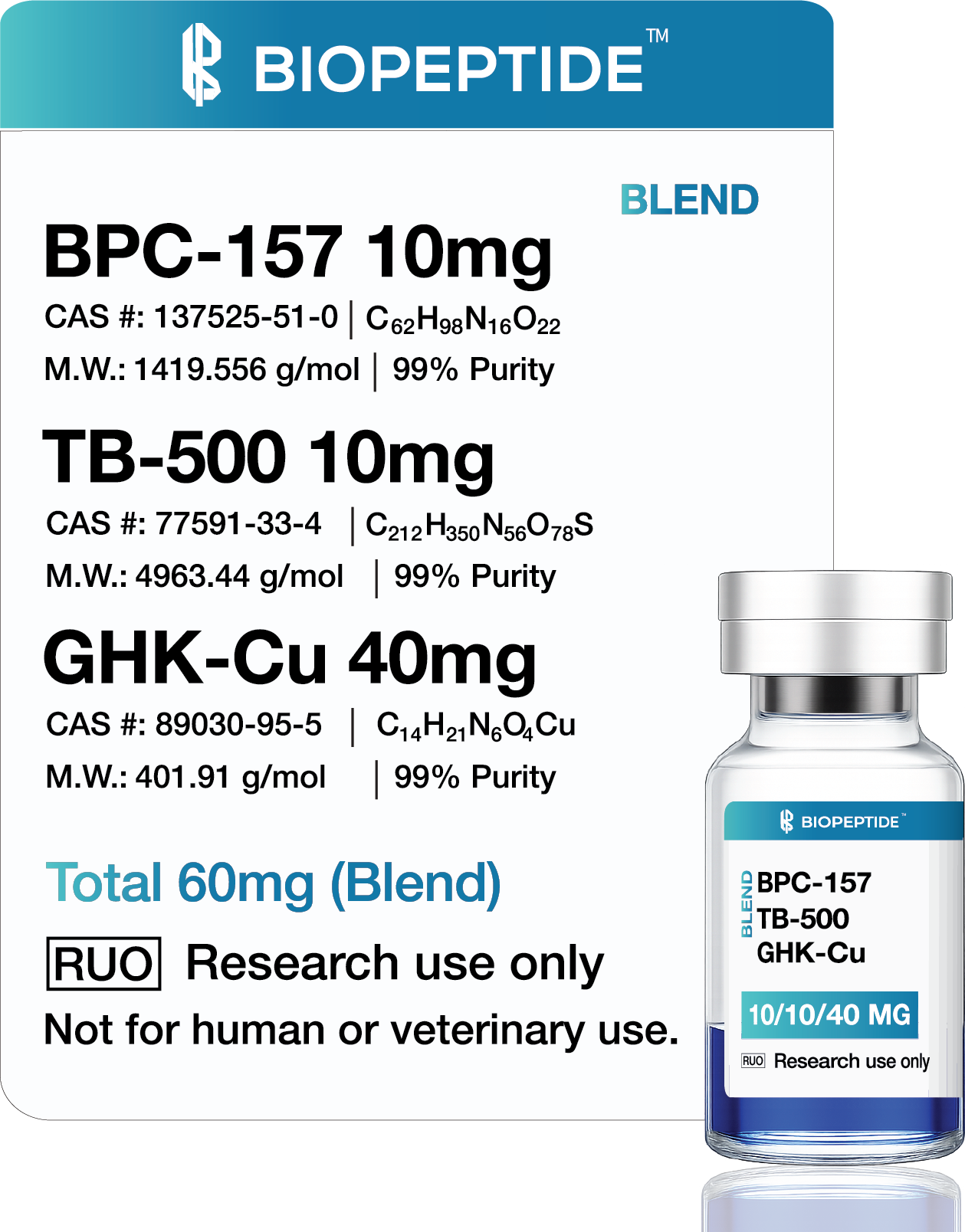
BPC-157 + TB-500 GHK-Cu Blend 60mg
CAS: 137525-51-0, 77591-33-4, 89030-95-5
BPC-157 + TB-500 Blend 60mg is a high-purity synthetic dual-peptide formulation engineered for advanced laboratory research applications. Manufactured using Solid-Phase Peptide Synthesis (SPPS) and validated through HPLC, Mass Spectrometry, and UV spectrophotometry, this blend ensures ≥99% purity, molecular integrity, and reproducibility. Identified by CAS 137525-51-0, 77591-33-4, and 89030-95-5, it is widely selected by European laboratories sourcing top peptides online for cellular signalling, protein interaction, angiogenesis modelling, and metabolic pathway research.
$315.00
Research Use Only
Advanced Synthetic Peptide System for Laboratory Investigation
BPC-157 + TB-500 Blend 60mg is a professionally engineered dual-peptide research compound supplied by Bio-Peptides for high-continuity in-vitro experimentation.
The formulation combines two extensively studied synthetic peptides under controlled production conditions to ensure batch-to-batch uniformity and reproducible molecular behaviour across experimental cycles.
Traceable via CAS 137525-51-0, CAS 77591-33-4, and CAS 89030-95-5, the blend supports transparent documentation, internal laboratory validation, and EU-aligned research compliance.
Designed for High-Continuity Research Workflows
Higher-dose peptide blends are increasingly preferred in modern biochemical and molecular research where experimental continuity and reduced variability are critical success factors.
The 60mg format minimises vial changes during long-term or multi-phase studies, supporting stable concentrations across comparative experimental designs.
European laboratories conducting grant-funded, publication-driven, and industrial research frequently select higher-dose peptide formats to improve reproducibility and logistical efficiency.
Blended peptide systems further reduce handling variability, preparation error, and contamination risk compared to combining individual peptide vials.
Research-Focused Molecular Behaviour
- Investigation of intercellular signalling coordination pathways
- Evaluation of molecular sensitivity to growth mediator signals
- Analysis of gene transcription and regulatory response models
- Assessment of enzymatic pathway responsiveness
- Exploration of mitochondrial, ATP-related, and energy-regulation processes
Common Laboratory Research Applications
Regenerative Cellular Modelling: Studying controlled cellular behaviour, migration, and matrix interaction patterns under defined in-vitro laboratory conditions.
Protein Synthesis and Degradation Studies: Evaluating transcriptional, translational, and peptide–protein interaction behaviour with high reproducibility.
Receptor-Binding and Affinity Assays: Investigating ligand–receptor dynamics, binding affinity, and signal activation thresholds.
Structural Matrix Research: Exploring extracellular structure behaviour, matrix organisation, and cellular microenvironments.
Metabolic and Mitochondrial Analysis: Assessing ATP production, mitochondrial response, and cellular energy-regulation pathways.
Enzymatic Response Profiling: Analysing enzyme activation, inhibition, and sensitivity across molecular signalling pathways.
Molecular Composition and Characteristics
- Component 1: BPC-157 (synthetic pentadecapeptide)
- Component 2: TB-500 (thymosin beta-4 analogue)
- Referenced Component: CAS 89030-95-5 for analytical traceability
- Structure: Linear synthetic peptide chains supplied as a blended formulation
- Dose Format: High-concentration 60mg blended vial
Stability and Storage Characteristics
- Supplied as a lyophilised powder for optimal molecular stability
- Recommended storage temperature: −20°C
- Sensitive to moisture, light exposure, and elevated temperatures
- Predictable degradation behaviour above room temperature
- Reconstituted solutions generally stable for 24–48 hours under refrigeration
Reconstitution Compatibility
- Bacteriostatic water
- Sterile saline
- Acid-adjusted buffer systems
- Selected analytical-grade organic solvents
Technical Specifications
product Name
BPC-157 + TB-500 Blend 60mg
cas
137525-51-0, 77591-33-4, 89030-95-5
purity
≥99% (HPLC verified)
unit Size
60 mg blended vial
form
Lyophilised peptide blend
synthesis
Solid-Phase Peptide Synthesis (SPPS)
analytical
HPLC, Mass Spectrometry, UV Spectrophotometry
molecular Structure
Linear synthetic peptide chains
stability
High under recommended laboratory storage
Quality Control and Documentation
- HPLC purity confirmation
- Mass Spectrometry molecular identity verification
- UV spectrophotometric concentration analysis
- Batch consistency and reproducibility testing
- Endotoxin and microbial screening
Regulatory Statement
BPC-157 + TB-500 Blend 60mg is supplied strictly for laboratory research and scientific investigation. It is not approved for use as a drug, food, cosmetic, or medical product and is not intended for human or animal consumption. Certificates of Analysis (COA) and Material Safety Data Sheets (MSDS) are available upon request to support EU institutional compliance.
Frequently Asked Questions
It is used exclusively in laboratory research to study cellular signalling, protein interactions, angiogenesis models, and molecular pathway behaviour under controlled in-vitro conditions.
The formulation includes CAS 137525-51-0 (BPC-157), CAS 77591-33-4 (TB-500), and CAS 89030-95-5 for full analytical traceability.
No. This product is strictly for laboratory research and is not approved for human, veterinary, or clinical applications.
The 60mg format supports extended studies, multiple experimental replicates, and reduced batch variability in advanced research projects.
Store the lyophilised powder at −20°C, protected from light and moisture.
Yes. Bio-Peptides supplies this blend across Europe with full analytical documentation.
Each batch is verified using HPLC, Mass Spectrometry, and UV analysis.
Bacteriostatic water, sterile saline, acidic buffers, and compatible analytical solvents are commonly used.