
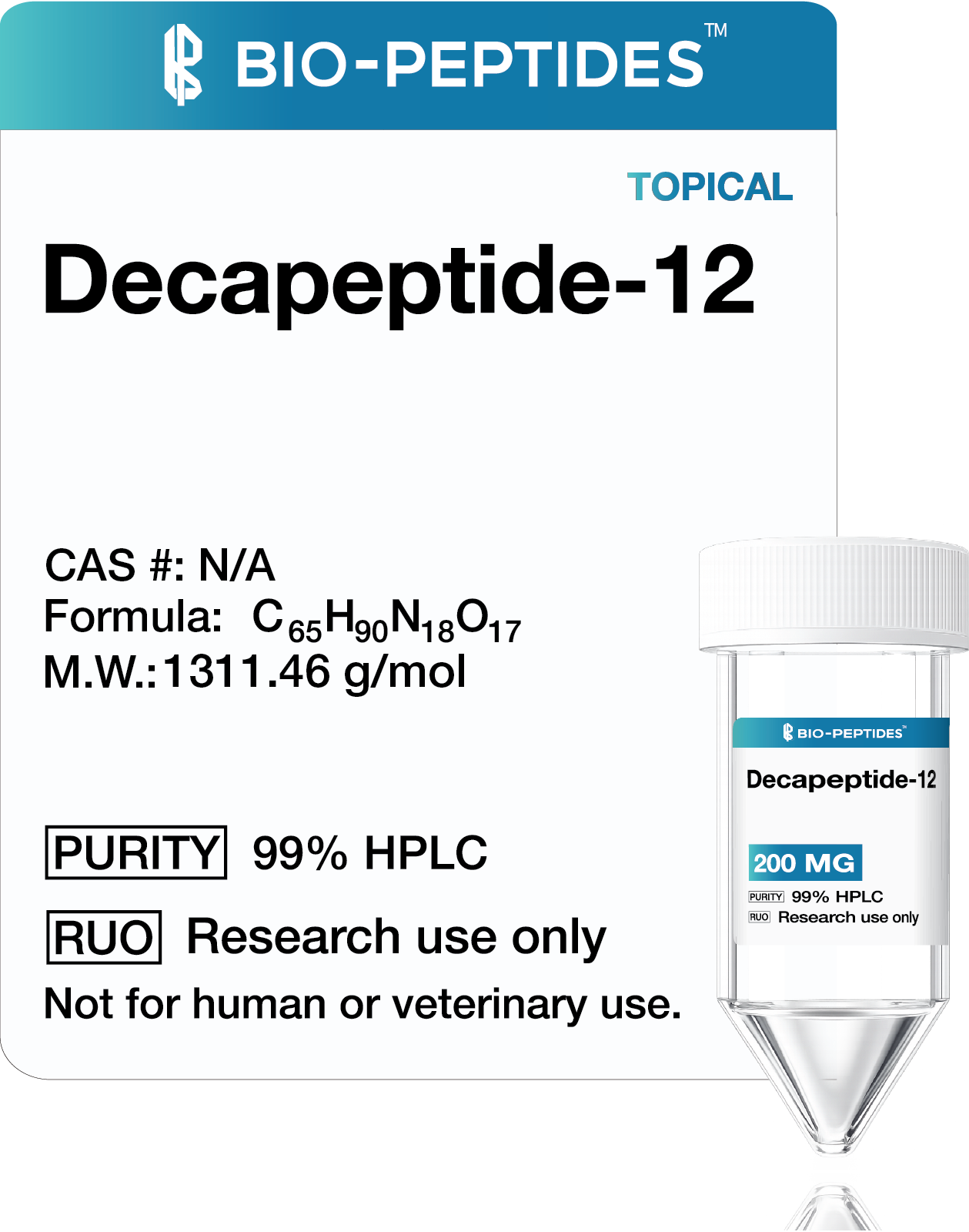
Decapeptide-12
CAS: 137665-91-9
Decapeptide-12, available from BioPeptides, is a laboratory-grade synthetic peptide engineered for high-precision research applications. Synthesised using advanced solid-phase peptide synthesis (SPPS) and verified via high-performance liquid chromatography (HPLC) and mass spectrometry (MS), Decapeptide-12 delivers exceptional molecular definition and analytical confidence. Supplied as a lyophilised powder, this peptide supports investigations in cellular signalling, peptide interaction networks, and protein regulation studies within controlled in-vitro environments. Trusted across Europe including research facilities in Germany, France, Italy, Spain, the Netherlands, and Belgium Decapeptide-12 is recognised among the top peptides online for experiments requiring rigorous quality, reproducibility, and scientific traceability.
$165.00
Research Use Only
Synthetic Peptide Research Overview
Decapeptide-12 is a synthetic peptide designed to support laboratory investigations into cellular signaling and peptide-mediated biochemical pathways.
Its defined linear peptide structure enables researchers to conduct reproducible experiments in molecular interaction studies and signaling pathway models.
Research institutions across Europe frequently use synthetic peptides like Decapeptide-12 to investigate biological signaling responses in controlled in-vitro environments.
Scientific Context and Research Significance
Synthetic peptides are valuable tools in biochemical and molecular research because they can interact with biological targets in a predictable and controllable manner.
Decapeptide-12 is commonly studied in laboratory environments examining melanogenesis pathways and peptide signaling networks associated with pigmentation biology.
Researchers use defined peptide structures to observe how peptide signaling influences receptor engagement, intracellular pathways, and downstream regulatory effects.
This approach provides a simplified experimental system compared to large proteins while still allowing detailed mechanistic analysis.
Mechanistic Research Perspective
- Targeted peptide signaling modulation in controlled cellular systems
- Mapping peptide–protein interaction behavior
- Observation of cellular responses to peptide-mediated cues
- Evaluation of regulatory feedback mechanisms within signaling networks
- Analysis of peptide-driven pathway modulation in in-vitro experiments
Primary Research Applications
Signal Transduction Assays: Used to investigate intracellular signaling effects and regulatory peptide interactions in biochemical research.
Protein Interaction Studies: Supports peptide–protein binding experiments in proteomics and structural biology research.
Gene Expression Research: Used in studies evaluating transcriptional responses to peptide-mediated signaling cues.
Molecular Network Analysis: Assists in understanding how peptides influence biochemical interaction networks within cellular systems.
Functional Cellular Modeling: Applied in controlled in-vitro experiments where peptide signaling contributes to experimental outcomes.
Molecular Characteristics
- Molecular Type: Synthetic linear decapeptide
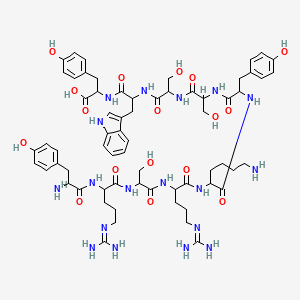
- Structure: Linear peptide composed of ten amino acid residues
- CAS Identifier: 137665-91-9
- Form: Lyophilized powder
- Molecular Weight: Approximately 1395 Da
- Stability: High under recommended laboratory storage conditions
Stability Profile and Storage Recommendations
- Supplied as a lyophilized powder for improved long-term stability
- Recommended storage temperature: −20°C
- Protect from moisture and prolonged light exposure
- Avoid repeated freeze–thaw cycles
- Reconstituted solutions typically remain stable for 24–48 hours under refrigerated conditions
Solubility and Reconstitution Options
- Bacteriostatic water
- Sterile saline solutions
- Mild acidic laboratory buffers
- Analytical organic solvents compatible with peptide assays
Technical Specifications
product Name
Decapeptide-12
brand
BioPeptides
cas
137665-91-9
purity
≥99% (HPLC verified)
unit Size
Research vial
form
Lyophilized powder
synthesis
Solid-Phase Peptide Synthesis (SPPS)
analytical
HPLC, Mass Spectrometry, UV Spectrophotometry
molecular Structure
Linear synthetic peptide
stability
High when stored appropriately
Analytical Validation and Quality Assurance
- High-Performance Liquid Chromatography (HPLC) purity verification
- Mass Spectrometry molecular identity confirmation
- UV spectrophotometric concentration analysis
- Batch-to-batch consistency validation
- Endotoxin and microbial contamination screening
Regulatory and Usage Statement
Decapeptide-12 is supplied strictly for laboratory research and scientific investigation. This product is not approved for human consumption, medical treatment, cosmetic application, or veterinary use. Certificates of Analysis (COA) and Material Safety Data Sheets (MSDS) are available upon request to support EU research documentation and institutional compliance requirements.
Frequently Asked Questions
Decapeptide-12 is used in molecular signalling studies, peptide–protein interaction assays, cellular responsiveness models, and gene regulatory research. It supports detailed examination of peptide effects within controlled in-vitro systems.
Its defined structure enables researchers to profile specific peptide bindings, monitor interaction dynamics, and measure affinities, providing clarity on protein interface behaviour under experimental conditions.
Yes. When stored at −20°C or below and protected from moisture and light, Decapeptide-12 maintains its chemical integrity. Reconstituted solutions remain stable for short-term experiments when refrigerated.
Yes. BioPeptides supplies Decapeptide-12 to qualified laboratories across Europe, including Germany, France, Italy, Spain, and the Netherlands, with documentation supporting analytical traceability and purchase verification.
Typical solvents include bacteriostatic water, sterile saline, mild acidic buffers, and compatible organic solvents depending on assay conditions.Decapeptide-12’s linear, well-defined sequence allows researchers to study specific regulatory effects with reduced conformational complexity compared to larger proteins, enabling clearer mechanistic interpretation.
Decapeptide-12 dissolves reliably in bacteriostatic water, sterile saline, mild acidic buffers, or compatible organic solvents. Solvent choice should match the assay’s sensitivity and analytical requirements.
No. This peptide is supplied strictly for research use and not approved for clinical, therapeutic, cosmetic, or human application.
BioPeptides offers strong analytical validation, documented purity, EU-compliant documentation, and reliable procurement processes, making it a trusted source for research laboratories.