
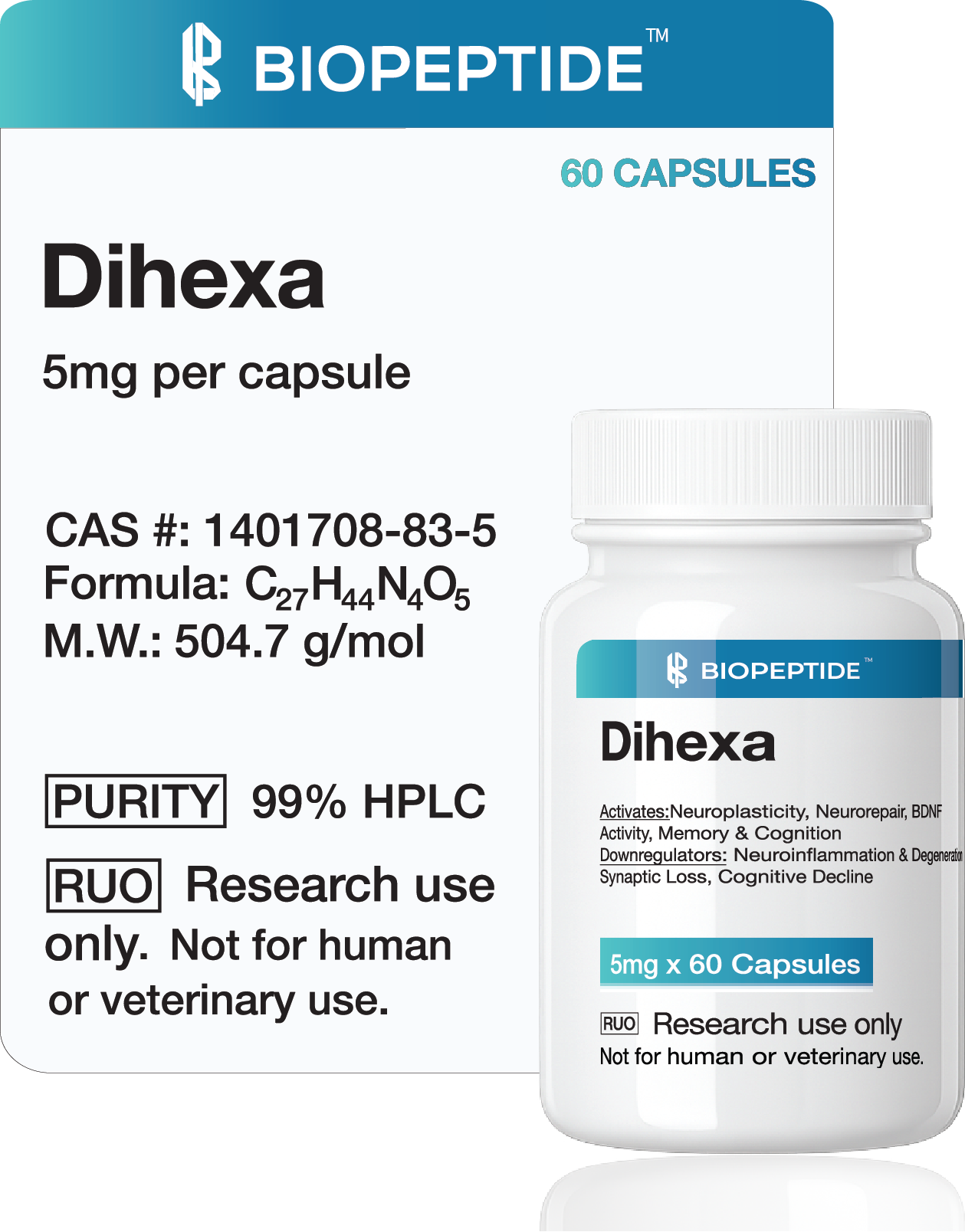
Dihexa 5mg (60 Capsules)
CAS: 1401708-83-5
Dihexa 5mg Capsules (60 Capsules / 300mg Total) | CAS 1401708-83-5 by BioPeptides are research-grade synthetic peptide capsules developed for advanced scientific and laboratory investigation. Identified by CAS 1401708-83-5, Dihexa is widely referenced in experimental molecular biology and neuroscience research for studying peptide–receptor interactions and cellular signalling mechanisms. Each capsule delivers precise peptide content to support reproducibility, consistency, and protocol accuracy. Manufactured under controlled conditions and supported by analytical validation, Dihexa 5mg Capsules are supplied strictly for research use and are trusted by laboratories across Europe seeking high-quality peptides from a reliable supplier.
$295.00
Research Use Only
Research Overview
Dihexa 5mg Capsules are a precision-formulated research compound designed for laboratory investigation of peptide-mediated cellular signaling systems.
Each vial contains 60 capsules delivering a total peptide content of 300mg, enabling controlled experimental protocols requiring consistent dosing formats.
European laboratories increasingly incorporate Dihexa into experimental models exploring synaptic signalling, receptor interactions, and molecular pathway modulation.
Scientific Context and Research Significance
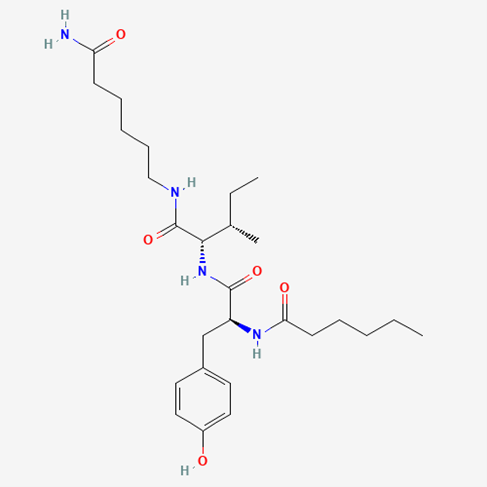
Dihexa is structurally derived from angiotensin-related peptide sequences and is widely referenced in experimental neuroscience and molecular biology research.
Synthetic peptides and peptide-derived compounds are valuable tools in life-science research because they allow precise investigation of receptor signaling and intracellular communication mechanisms.
Researchers frequently use Dihexa as a biochemical probe to examine how peptide-derived molecules influence cellular signaling pathways under controlled laboratory conditions.
Institutions across Germany, France, Italy, Spain, the Netherlands, and Belgium rely on well-characterized research peptides like Dihexa for reproducible and analytically verified experimental outcomes.
Mechanistic Research Perspective
- Modulation of cellular signaling pathways in experimental models
- Investigation of peptide–receptor interaction mechanisms
- Evaluation of growth-factor related cellular responses
- Observation of transcriptional and gene expression changes in response to peptide signals
- Analysis of neuronal communication and synaptic modeling systems
Primary Research Applications
Molecular Neuroscience Studies: Used in laboratory research models investigating synaptic communication, neuronal signaling, and cellular adaptation mechanisms.
Peptide–Receptor Interaction Assays: Supports experiments examining receptor binding behavior and peptide signaling dynamics.
Signal Transduction Analysis: Applied in studies exploring intracellular signaling cascades and regulatory peptide pathways.
Cellular Response Modeling: Used to observe how cells respond to peptide-derived compounds within defined experimental conditions.
Biochemical Pathway Mapping: Supports experimental designs aimed at understanding complex molecular interaction networks.
Molecular Characteristics
- Molecular Type: Synthetic peptide-derived small molecule
- Structure: Linear peptide analogue
- CAS Identifier: 1401708-83-5
- Form: Encapsulated research compound
- Molecular Weight: Approximately 814.0 Da
- Stability: High under recommended storage conditions
Storage and Stability Recommendations
- Store capsules in a cool, dry environment
- Refrigeration is recommended for extended storage
- Protect from direct light exposure
- Keep containers tightly sealed to prevent moisture contamination
- Handle with care to maintain experimental consistency
Handling and Laboratory Preparation
- Capsule format provides fixed peptide quantity per unit
- Supports consistent experimental dosing
- Reduces handling variability in comparative research studies
- Allows simplified protocol standardisation in repeat experiments
Technical Specifications
product Name
Dihexa 5mg Capsules
brand
BioPeptides
cas
1401708-83-5
purity
≥99% (analytically verified)
unit Size
5mg per capsule
total Content
300mg (60 capsules)
form
Encapsulated research compound
synthesis
Controlled synthetic peptide production
analytical
HPLC, Mass Spectrometry, UV Spectrophotometry
molecular Structure
Peptide-derived small molecule
stability
High when stored appropriately
Analytical Validation and Quality Assurance
- High-Performance Liquid Chromatography (HPLC) purity verification
- Mass Spectrometry molecular identity confirmation
- UV spectrophotometric concentration validation
- Batch-to-batch consistency verification
- Contaminant screening in line with laboratory research standards
Regulatory and Usage Statement
Dihexa 5mg Capsules are supplied strictly for laboratory research and scientific investigation. This compound is not approved for human consumption, medical treatment, veterinary use, or cosmetic formulation. Certificates of Analysis (COA) and Material Safety Data Sheets (MSDS) are available to support institutional compliance and laboratory documentation requirements.
Frequently Asked Questions
Dihexa is used in laboratory studies focused on cellular signalling, peptide-receptor interactions, and molecular communication pathways. It serves as a research tool for exploring peptide-driven mechanisms in controlled experimental models.
No. Dihexa 5mg Capsules are supplied strictly for scientific research purposes and are not approved for human, medical, or therapeutic use under EU regulations.
The CAS number 1401708-83-5 uniquely identifies Dihexa as a chemical substance, ensuring traceability, consistency, and accurate referencing across scientific publications and laboratory documentation.
Capsules provide consistent peptide quantities, reduce handling variability, and simplify protocol standardisation, making them valuable in comparative and repeat-run experimental studies.
Dihexa capsules should be stored in a cool, dry environment, protected from light and moisture. Proper storage helps preserve molecular stability for ongoing research projects.
Yes. BioPeptides supplies Dihexa 5mg Capsules to qualified research customers across Europe, including Germany, France, Italy, Spain, and the Netherlands, with appropriate documentation.
BioPeptides uses HPLC, mass spectrometry, and batch verification processes to confirm purity, identity, and consistency, supporting reliable scientific outcomes.
Within research communities, Dihexa is widely referenced due to its stability, documented properties, and relevance to advanced molecular studies, placing it among frequently sourced research peptides.