
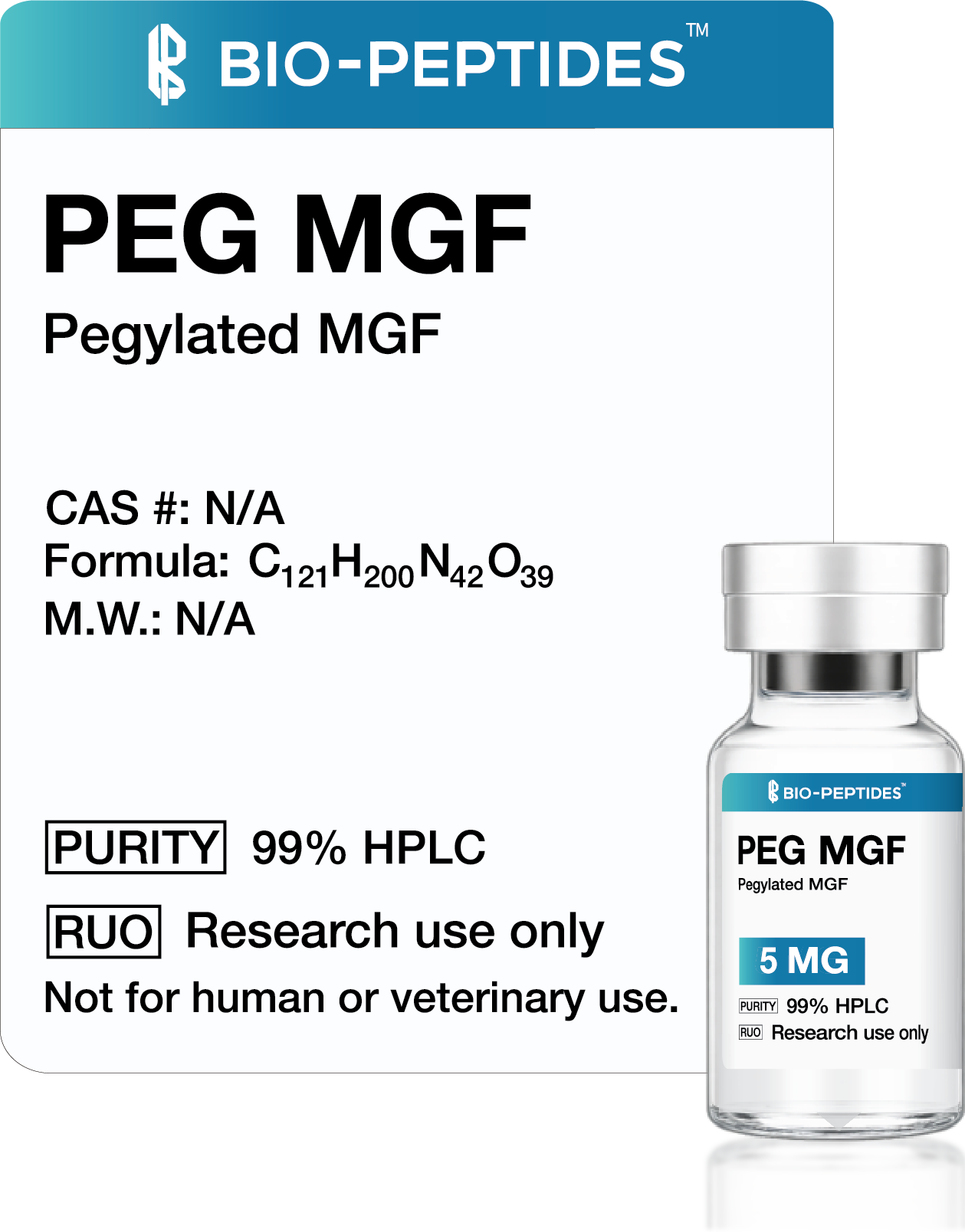
PEG-MGF 5mg
CAS: Not assigned
PEG-MGF 5mg by BioPeptides is a high-purity research-grade PEGylated growth factor peptide designed for advanced laboratory studies involving muscle signaling pathways, cellular response mechanisms, and growth-factor-mediated communication systems. PEGylation improves molecular stability and resistance to enzymatic degradation, allowing researchers to observe extended peptide signaling dynamics in controlled experimental environments.
$295.00
Research Use Only
Research Overview
PEG-MGF is a PEGylated analog of Mechano Growth Factor studied in laboratory research involving growth-factor signaling pathways.
Researchers investigate PEG-MGF to analyze cellular response mechanisms associated with mechanical stimulation and growth signaling.
The PEGylation process enhances peptide stability, allowing researchers to observe signaling effects over extended experimental periods.
PEG-MGF is widely used in molecular biology and regenerative research models studying tissue signaling behavior.

Scientific Background
Mechano Growth Factor (MGF) is a splice variant of the IGF-1 gene that is involved in cellular signaling related to tissue adaptation.
PEGylation involves attaching polyethylene glycol molecules to peptides to improve stability and experimental longevity.
In laboratory research, PEGylated peptides are often used to extend observation windows and reduce degradation during experimental protocols.
PEG-MGF allows researchers to analyze growth-factor signaling and tissue response mechanisms in controlled research environments.
Mechanistic Research Perspective
- Growth-factor-mediated cellular signaling research
- Tissue response pathway investigation
- Cellular communication and adaptation signaling
- Comparative studies of PEGylated vs non-PEGylated peptides
- Peptide stability and molecular signaling analysis
Primary Research Applications
Growth Factor Signaling Research: PEG-MGF is used in laboratory models investigating growth-factor signaling pathways and cellular response systems.
Muscle Biology Research: Researchers study PEG-MGF to explore cellular communication mechanisms associated with muscle-related signaling models.
Regenerative Biology Studies: PEG-MGF supports investigations into cellular repair processes and tissue response pathways.
Molecular & Cellular Biology: Scientists use PEG-MGF in in-vitro assays examining peptide-mediated signaling responses.
Comparative Peptide Research: Used in studies comparing PEGylated peptides with non-PEGylated growth factor peptides.
Molecular Characteristics
- Compound Name: PEG-MGF
- Peptide Class: PEGylated growth factor peptide
- Form: Lyophilized peptide powder
- Purity: Research-grade analytical quality
- Unit Size: 5 mg research peptide
Stability Profile and Storage Recommendations
- Store lyophilized peptide at −20°C
- Protect from moisture and direct light
- Avoid repeated freeze–thaw cycles
- Reconstitute using sterile laboratory-grade solvent
- Seal vial tightly after each use
Solubility and Preparation Considerations
- Soluble in sterile aqueous research buffers
- Compatible with molecular biology research systems
- Applicable in growth-factor signaling assays
- Suitable for cellular signaling pathway experiments
- Compatible with peptide stability research protocols
Technical Specifications
product Name
PEG-MGF 5mg
brand
BioPeptides
purity
Research-grade analytical quality
form
Lyophilized peptide powder
synthesis
Precision peptide synthesis with PEGylation
analytical
Identity and purity verification
molecular Structure
PEGylated mechano growth factor peptide
stability
Stable under −20°C laboratory storage
Analytical Validation and Quality Assurance
- Molecular identity confirmation
- Purity and stability analysis
- PEGylation consistency verification
- Batch-to-batch reproducibility testing
- Laboratory quality control validation
Regulatory and Compliance Statement
PEG-MGF supplied by BioPeptides is intended strictly for laboratory research use only. It is not approved for human consumption, veterinary use, therapeutic applications, or medical treatments.
Frequently Asked Questions
PEG-MGF is used in laboratory research studying growth-factor signaling, cellular response mechanisms, and regenerative pathway models.
PEGylation refers to attaching polyethylene glycol molecules to the peptide, improving stability and resistance to degradation in research environments.
PEG-MGF offers increased stability and longer experimental observation windows compared to non-PEGylated MGF.
Yes. PEG-MGF is widely used in controlled in-vitro experiments studying growth-factor signaling and cellular communication.
PEG-MGF is used in muscle biology research, regenerative biology studies, molecular biology, and peptide signaling research.
The 5mg quantity supports targeted experiments and provides cost efficiency for laboratories conducting specialized peptide research.
PEG-MGF should be stored at −20°C, protected from moisture and light, and handled using sterile laboratory procedures.