
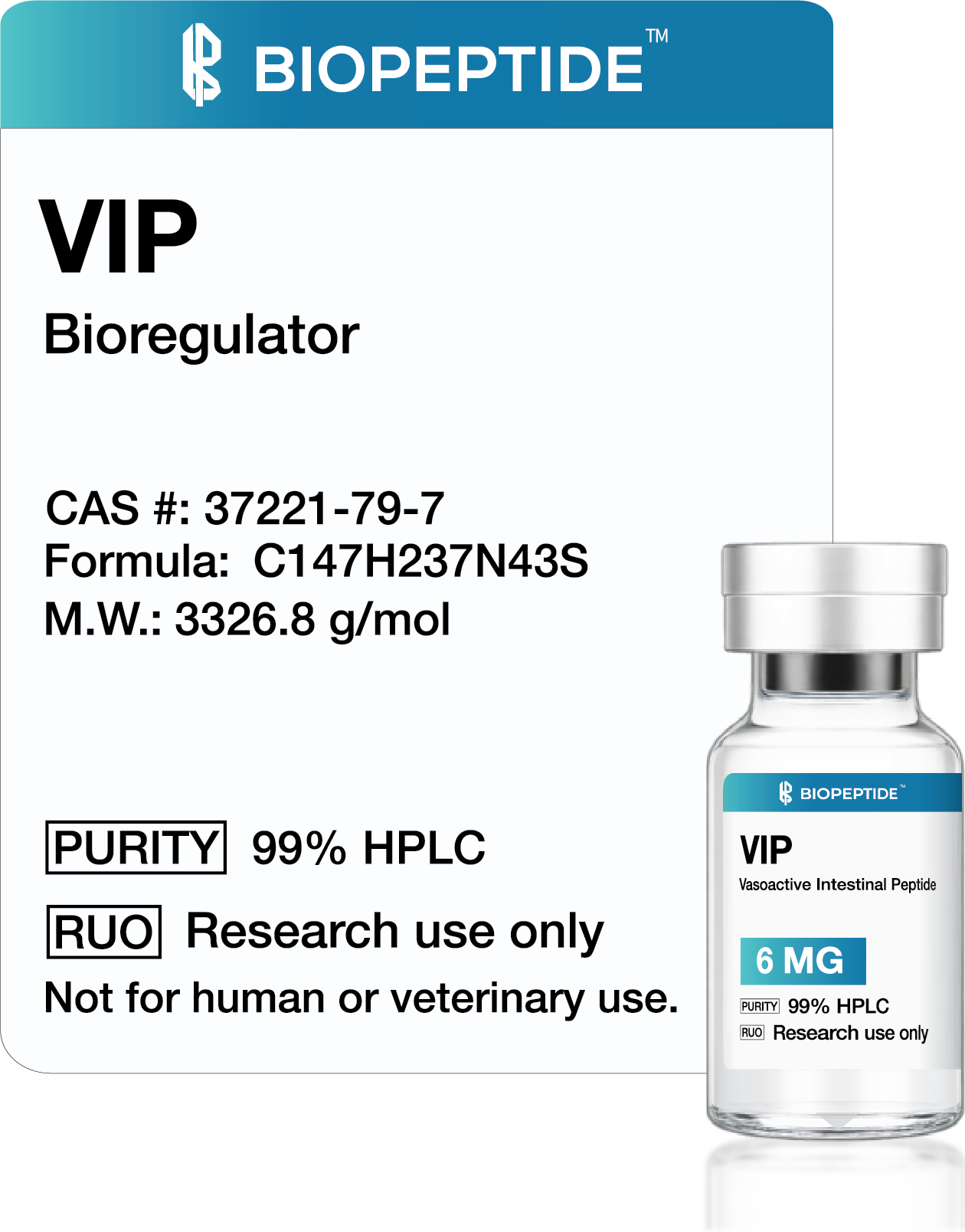
VIP (Vasoactive Intestinal Peptide) 6mg
CAS: 37221-79-7
VIP 6mg (Vasoactive Intestinal Peptide) by Bio-Peptides is a high-purity research-grade neuropeptide supplied for advanced laboratory investigations in vascular signaling, neuroimmune communication, and smooth muscle regulatory pathways. Identified by CAS 37221-79-7, VIP is widely studied for its role in peptide-mediated cellular signaling, vasodilation mechanisms, and immune communication networks. The 6mg research format is suitable for focused in-vitro and preclinical research experiments in neurobiology, vascular biology, and peptide signaling models.
$185.00
Research Use Only
Research Overview
VIP (Vasoactive Intestinal Peptide) is a naturally occurring 28-amino-acid neuropeptide involved in communication between the nervous, immune, and vascular systems. In laboratory research environments, synthetic VIP enables scientists to investigate complex peptide-mediated signaling networks under controlled conditions.
The synthetic VIP 6mg research format supplied by Bio-Peptides is used in studies exploring neuropeptide signaling, receptor activation mechanisms, and smooth muscle regulatory pathways. The peptide’s well-characterized biological activity makes it a valuable model compound for understanding peptide-driven cellular communication.
VIP research peptides are commonly used in neurobiology, vascular biology, immunology, and molecular signaling studies where peptide-mediated communication plays a central role in experimental models.
Scientific Background
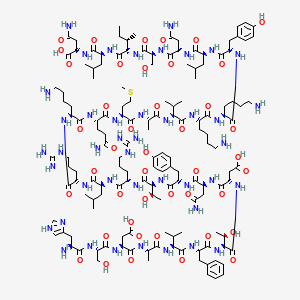
Vasoactive Intestinal Peptide (VIP) is a multifunctional neuropeptide produced naturally in the nervous system, gastrointestinal tract, and peripheral tissues. Identified by CAS 37221-79-7, VIP plays a role in vasodilation signaling, smooth muscle relaxation, and neuroimmune communication.
In laboratory research, synthetic VIP is used to explore interactions between neuronal signaling networks, vascular tissue regulation, and immune cell communication pathways. Due to its broad biological relevance, VIP is considered an important peptide for investigating complex signaling interactions across multiple biological systems.
Mechanistic Research Properties
- In laboratory research settings, VIP is investigated for its influence on several biological signaling mechanisms.
- Activation of VIP receptors involved in neuropeptide signaling pathways
- Regulation of vascular tone and vasodilation signaling
- Interaction with immune cell communication networks
- Influence on smooth muscle relaxation pathways
- Participation in neuroimmune and neurovascular signaling cross-talk
Primary Research Applications
Vascular Signaling Research: Used in laboratory models to investigate vasodilation pathways and endothelial communication mechanisms involved in vascular regulation.
Neuroimmune Interaction Studies: Applied in studies exploring communication between neuronal signaling molecules and immune cell responses.
Smooth Muscle Regulation Models: Used in experiments examining peptide-mediated smooth muscle relaxation and regulatory signaling mechanisms.
Neuropeptide Receptor Research: Supports investigation of VIP receptor activation, ligand binding behavior, and downstream cellular signaling responses.
Comparative Neuropeptide Studies: Used to compare signaling mechanisms of VIP with related neuropeptides such as PACAP and neurotensin.
Molecular Characteristics
- Peptide Class: Neuropeptide
- Peptide Length: 28 amino acids
- Structure: Linear peptide chain
- Molecular Behavior: Active in receptor-mediated signaling models
Stability and Storage Profile
- Stable when stored lyophilized at −20°C
- Sensitive to moisture and prolonged light exposure
- Peptide stability decreases at elevated temperatures
- Reconstituted solutions should be refrigerated
- Avoid repeated freeze–thaw cycles to preserve peptide integrity
Solubility and Reconstitution Options
- Bacteriostatic water
- Sterile saline solutions
- Mild buffer systems compatible with peptide assays
- Analytical solvents used in laboratory peptide research
Technical Specifications
product Name
VIP (Vasoactive Intestinal Peptide) 6mg
cas
37221-79-7
purity
≥98–99% (HPLC verified)
unit Size
6 mg
form
Lyophilized powder
synthesis
Solid-Phase Peptide Synthesis (SPPS)
analytical
HPLC, Mass Spectrometry
Analytical Validation and Quality Control
- High-Performance Liquid Chromatography (HPLC) purity verification
- Mass Spectrometry molecular identity confirmation
- Peptide structural integrity analysis
- Batch-to-batch consistency evaluation
- Quality control screening for contamination
Regulatory and Compliance Information
VIP 6mg is supplied strictly for laboratory research purposes. It is not approved as a pharmaceutical product, dietary supplement, cosmetic ingredient, or medical treatment. The peptide is intended exclusively for controlled scientific investigations and in-vitro laboratory studies. Any form of administration to humans or animals is strictly prohibited. Researchers must comply with applicable regulations in Europe, the United States, and their institutional research policies.
Why Source from Bio-Peptides?
Bio-Peptides is a trusted supplier of research peptides serving laboratories and research institutions across Europe and the United States. The company provides high-purity peptides with verified CAS documentation, strict research-only compliance, and consistent analytical validation. Researchers sourcing VIP 6mg from Bio-Peptides benefit from reliable supply, transparent specifications, and professional laboratory packaging designed for scientific research environments.
Frequently Asked Questions
VIP is used in laboratory research to study neuropeptide signaling pathways, vascular regulation, immune cell communication, and smooth muscle signaling mechanisms.
CAS 37221-79-7 uniquely identifies Vasoactive Intestinal Peptide (VIP) and ensures accurate compound identification in research laboratories.
VIP is classified as a neuropeptide rather than a classical hormone and functions as a signaling molecule within neural and vascular communication systems.
VIP is widely studied in neurobiology, vascular biology, immunology, molecular biology, and peptide signaling research.
Yes. VIP is commonly used in in-vitro and ex-vivo experimental models to investigate receptor signaling, neuropeptide communication, and vascular signaling pathways.
The 6mg research format is suitable for pilot studies, targeted experiments, and comparative peptide research requiring controlled quantities.
VIP should be stored at −20°C in lyophilized form, protected from moisture and light, and handled using sterile laboratory techniques.
Bio-Peptides provides research-grade peptides with verified CAS documentation, reliable international shipping, and strict compliance with research-only standards.